Episode Transcript
Real AI Use Cases Ep 21 - Dr. Patrick Porter
Sherrill: [00:00:00] With HeyGen, you can create a clone of yourself and after you create that clone, you can create different scenes and background. Your clone can walk.
Lynn: In the world of prompting engineering, you have to have a very specific prompt. That takes a real learning curve
Dr Patrick: When somebody searches, they can ask it a question, and it's like me giving them the recommendation. It freed me up tremendously
Richard: It's like a gold rush right now. Everybody is filing patents on artificial intelligence.
Elizabeth: A lot of people say I tried doing a clone, it didn't work. So you have to go into, you have to have a lot of light I found, and a really good camera and a really good microphone
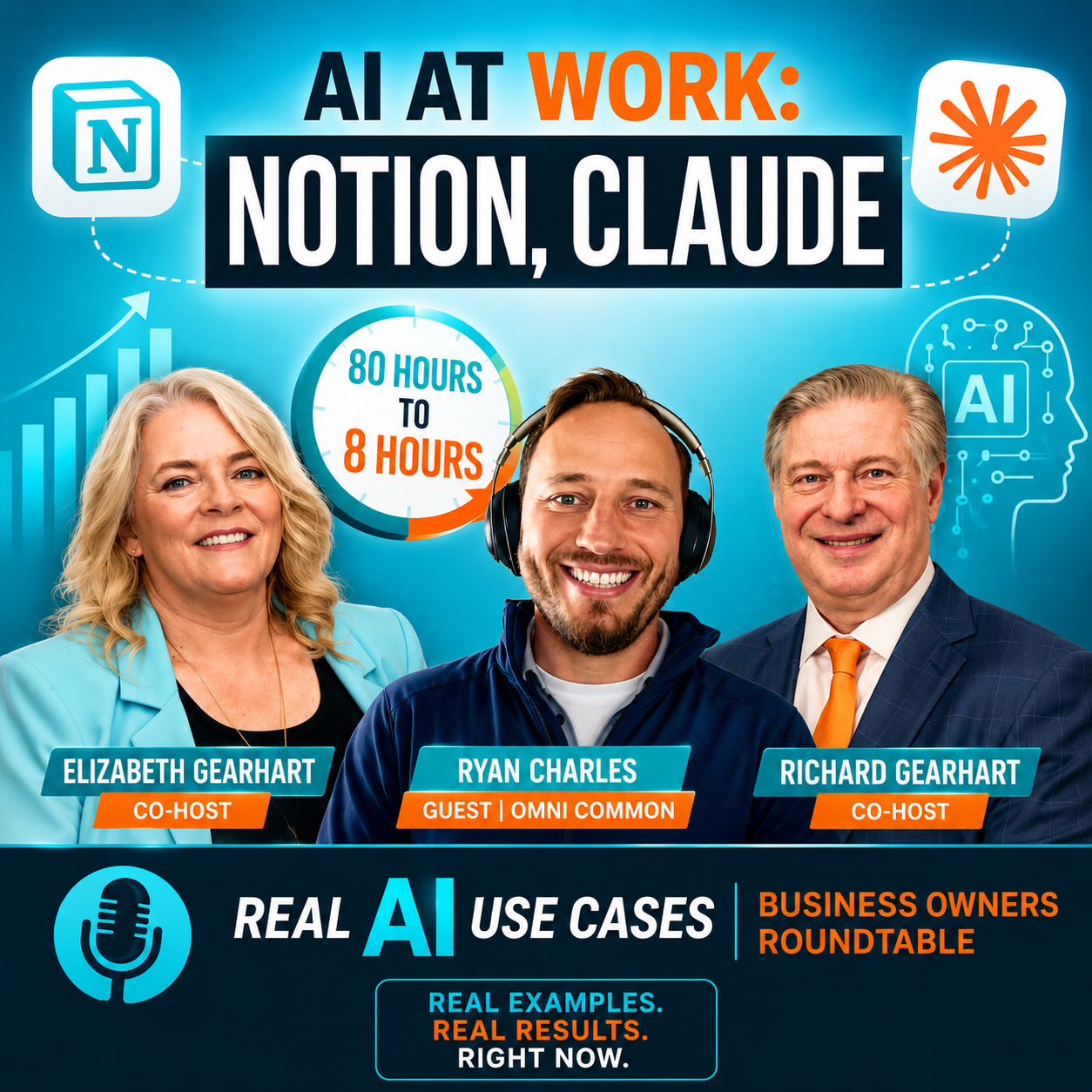
Real AI Uses Cases: this is real AI use cases, business owners, round table with hosts, Elizabeth Gearhart, podcast consultant, marketing expert and PhD researcher using AI every day. And Richard Gearhart entrepreneur, seasoned business owner and intellectual property attorney specializing in innovation. Here's how real companies are using AI right now.
Richard: And now [00:01:00] it's time.
Elizabeth: Time for Real AI Use Cases, business owners round table. So I'm gonna ask everybody here one way, like their favorite way that they're using AI in their business. We'll go through that and then we're gonna just do a round table where we talk about all the different ways people are using AI.
So Dr. Patrick Porter, what is your favorite way that you're using AI?
Dr Patrick: Well, my biggest question on my app, because we have 3000 different sessions on there is, what do I listen to? So we created Dr. PAI and it took every book I've written, I've written 11 books.
It took every lecture I've ever given, put it all into AI, and that thing's smarter than me, really. I mean, when I ask you questions, it comes up with some really good things, but it stays inside the bounds of what I've written and done, and it's on our app. So now when somebody searches, they can ask it a question, and it's like me giving them the recommendation.
It freed me up tremendously because that's probably the biggest thing that I do.
Elizabeth: Sherrill Mosee. What is one way you're using AI?
Sherrill: I'm actually cloning [00:02:00] myself to help with marketing so I don't have to do individual videos myself.
Elizabeth: That's excellent. I'm right there with you and Lynn Rogoff.
What's one way, I know you're using AI all over the place, right? What's your favorite way right now?
Lynn: So we are generating motion pictures with AI and we are using software like Cling and Runway and Sora. That is one of the ways that we generate the images and to generate the prompts, to get the images is, we use Chat GPT to help us with generating a well-written prompt.
So the, in the world of prompting engineering, you have to have a very specific prompt. So that is, that takes a real learning curve, learning how to write good prompts and so that Chat, GPT helps us do that.
Elizabeth: I love what you just [00:03:00] said, Richard Gearhart, what is one your favorite way you're using AI right now?
Richard: My favorite way, oh, let me count the ways. What I really wanted to talk about was the vast number of projects that we're getting at the law firm now for people who are filing patents on AI and I am just really impressed with the scope of technologies, the industries that people are using to apply AI areas that you just wouldn't even think need AI. But people who are experts in those areas who have domAIn expertise are coming up with ways to utilize AI for their everything from fitness to asset management, to real estate to security.
There's just a whole universe of new applications that people are protecting with patents. I just wanted to say it's like a gold rush right now. It's everybody is [00:04:00] filing patents on artificial intelligence.
Elizabeth: Yeah. So for me, Elizabeth Gearhart, I'm with Sherrill's.
So I just made my AI clone and I did it in our studio. So a lot of people, and Sherrill may, you may have had the same experience. A lot of people, if you tell 'em, they say, well, I tried doing a clone, it didn't work. So you have to go into, you have to have soup, a lot of light I found, and a really good camera and a really good microphone.
And you have to go through your whole range of emotions and talk for about 10 minutes to get something that comes out decent. And I tried it as a YouTube short, but I used a, a script from Google Gemini. And it bombed. It totally bombed. So I'm gonna try putting in more natural sounding scripts and try using it.
But people that see it, like my friends are like, oh my gosh,
Richard: I thought it was a really good video. Yeah, I was surprised it didn't get better, better traction. But it's really a question about how people are gonna be responding to [00:05:00] AI created footage.
Elizabeth: I'm gonna keep experimenting.
So I know that different people here are using AI in different ways. What have been your experiences? Like sometimes it bombs, sometimes it works. What do you guys think?
Lynn: So there's a technology called DID, which makes AI agents with your image or their image and controls the knowledge base. We've been using it.
We made six characters from our film where you can go and ask the characters any question you want. So I always recommend using a technology that's been tested and proven and iterated and they have come up with the state of the art for AI agents and I highly recommend them. And they're very, have great support and you can go and look at their website and we looked at it yesterday and we couldn't believe that it was not a [00:06:00] real person speaking. So they've really developed their software. I really recommend it.
Elizabeth: Well, I'm trying to figure out right now where to put all of my content to start generating the clone like Dr. Patrick has because there's different, like I use personalized Gemini Chat has its own and I am not really sure the best place to put all the content to synthesize it down to the essence of me to be able to answer people's questions.
Dr. Porter, where do, are you putting yours?
Dr Patrick: I hired someone to do it. So I'm not an AI expert, but I've been using it a long time now, and they just gave me a place to put all the new content as I created and they added it to it.
And it works inside of Chat, GPT, and I know people, so you're doing it.
I've not had good luck with Claude or with. The others doing it. And I had somebody try to do a video of me, and I'm not there yet. So I'm Sherrill. I'm really, [00:07:00] interested to see your end result because mine, I look like an Indian guy and spoke like it wouldn't even sound like me. I'm going, that's not me.
I want it to be so realistic that they can't tell like what you're saying, and I think AI's gonna get there. I just don't have the right, but I love what Lynn said, and I'm, I'm gonna look up DID because, yeah,
Elizabeth: I wanna ask you, Lynn, so can you put all your content into DID and have it generate your thought clone?
Or is it just your video clone?
Lynn: They have something called the knowledge base. And you can have your own knowledge base or you can have a hybrid, meaning that it's your knowledge that you feed the AI agent, combined with what they find on the internet. Or just the internet.
So we wanted to control our knowledge base and we fed it the knowledge that we wanted the agent to speak. And it's really designed for the enterprise solution we used it for filmmaking storytelling, but it's the same technology [00:08:00] and they also have behaviors.
So if you want the hands to move or you want the lot of facial expression, or you want a friendly. Characteristics, you wanna be a, or you wanna be professional. You could choose the behavior of the agent as well as the knowledge base and the format in which the agent replies to your query.
Elizabeth: Excellent.
Thank you. I wanna go back to Sherrill what are you using for your clone?
Sherrill: I'm using a couple of things, but the biggest one that I use is called HeyGen. That's what I used. I think HeyGen is pretty good about. You know, six and eight months ago, it was horrible. But these AI tools changed so fast and they improved so fast.
So with HeyGen, you can create a clone of yourself and after you create that clone, you can create different [00:09:00] scenes and background. You can tell it what you want it to wear. You can walk, your clone can walk. There's another tool that's called Creatify . And I use that for UGC AI avatars , because I'm marketing my product, I want to have other people talking about the product and not me so much.
I think those tools are great. And then I learned, that Google, you can create some, avatars in there as well.
Richard: Wow.
Elizabeth: Oh yeah. So what about you, Richard?
Richard: Well, I'm not sure the world's ready for a clone of me because you didn't want a
Elizabeth: clone of me.
Richard: My jokes are, are not funny enough that to have something that repeats them would just probably be a disaster for the whole human race.
But. Oh, I'm ready to try one. I just wonder, I worry as an attorney, we give legal advice, right? We can't give wrong legal advice. Right, right. And so I'm [00:10:00] just kind of curious about how accurate these models are. It's one thing to give an opinion about something. May not matter quite so much, but Dr. Porter, if you're talking about brain health, you wanna get it right, right? You don't want people doing the wrong thing because AI has hallucinating, right?
Sherrill: So, in HeyGen , you can actually script how you want your AI to talk. So you give it the information in HeyGen? Yeah, which is, which is really good. 'cause I can talk about anything, but it'll be my, my avatar, my clone.
Elizabeth: Yeah. I,
Dr Patrick: one, we, I love that found year. Ring gap is, my wife's probably got a legal degree now. She was using Chat GPT, and then she gives it to our attorneys who use Harvey, which is the AI for legal.
And we've saved a lot of money because we've done all the work with AI to get case studies, and then we get, of course, we're not lawyers, so we have to still turn it over to the legal team, but it has saved us a great deal of money and got them going [00:11:00] in the right direction.
Sherrill: Don't think Richard wants to hear that.
Elizabeth: No, but it's, it's not always accurate. Like 70% there because we had our assistant looked up a reply to a question on a video we did and AI gave her the completely wrong answer. Yeah, totally wrong. We had to tell her, no, you cannot post that. But I wanna go back to something Lynn said too. Lynn, you mentioned Enterprise, so it's, can you talk about how important it's to use enterprise if you don't want your data shared?
Lynn: In this particular software, which we have a partnership with them and they've supported our character generator. Knowledge base avatars and they make a solution for people who are selling business to business or business to consumer who want to have a representation of the business in the avatar so that solution is going to be more bigger and [00:12:00] bigger in the world of enterprise and the world of education that, you know, it's, it's becoming ubiquitous.
Elizabeth: So for business at least, they have much higher safeguards on your content than if you're using a free version.
Lynn: Exactly. That's why I'm saying, I'm suggesting where you control the knowledge base, like Sherrill was saying, you, oh, you tell it this is what I want you to get. You could do a Q and A. When you write the script for the knowledge for the avatar, you could give the question and the answer, or you can combine it with the knowledge base and you give it, let's say in Dr. Porter's situation, he could put his books up there and the avatar will only pick from his books. It won't go into the internet or Chat GPT. It'll only be from his books. So you wanna control what the knowledge base of the avatar is.
Elizabeth: [00:13:00] Right. So Dr. Porter, where are you located?
Dr Patrick: I'm in New Bern, North Carolina.
Elizabeth: Oh, too far. I was gonna say, if you're ever up in this area, come to my studio. I'll make the perfect avatar for you. I, we have a tried and true method.
Dr Patrick: Well, sweet. Where are you at?
Elizabeth: We're in New Jersey.
Dr Patrick: Okay. So I travel all the time, so I'll keep that in mind next time I'm up in the New York, New Jersey.
Richard: It would be awesome to meet you in person for sure.
Elizabeth: Well thank you everybody this has been Real AI Use Cases, business owners, round table.
Real AI Uses Cases: You have been listening to real AI use Cases, business Owners Roundtable. We hope you found this valuable. Join us again for more stories because the future of business is driven by AI. This podcast was recorded at the iHeart Studios in Manhattan as part of the Passage to Profit Radio show.