Episode Transcript
[00:00:00] Speaker A: When it comes to content, the human touch is still the best. If you over engineer it with AI, then it comes across as over engineered with AI.
[00:00:08] Speaker B: I'm really quite excited about actually ingesting around 15 terabytes of historic content from events and testing. I think we're getting very close to being able to just point. An AI documentary maker agent.
[00:00:22] Speaker C: I call it my best friend. It's my assistant. When it's my assistant that I don't have to pay 20 to $30 an hour.
[00:00:30] Speaker D: We're a video surveillance company using artificial intelligence to detect threatening activities before they occur and to eliminate them.
[00:00:41] Speaker E: One thing we struggle with YouTube is retaining listeners and viewers. That's really what Google looks at with your content.
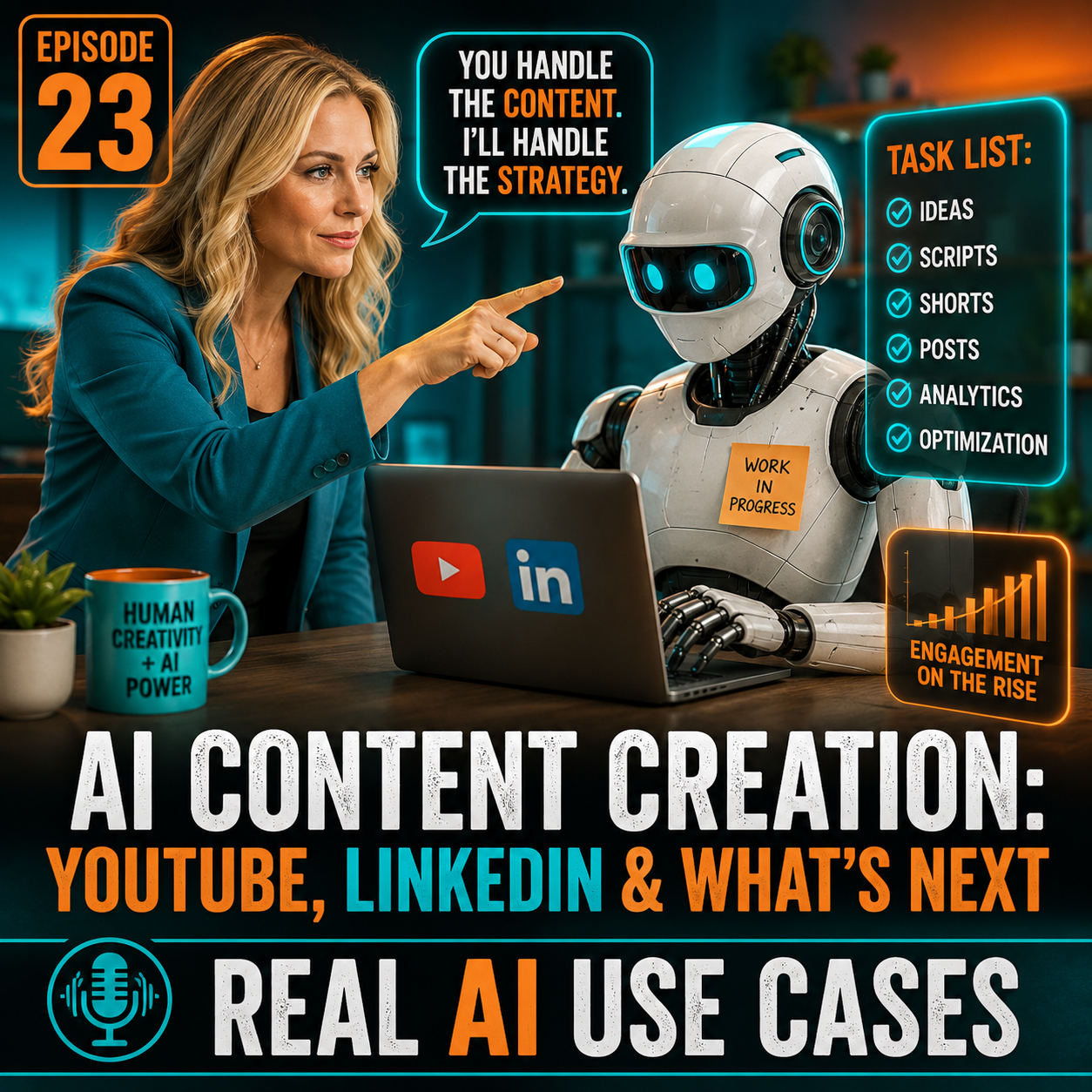
This is real AI Use Business Owners Roundtable with hosts Elizabeth Gearhart, podcast consultant, marketing expert and PhD researcher using AI every day. And Richard Gearhart, entrepreneur, seasoned business owner and intellectual property attorney specializing in innovation. Here's how real companies are using AI right now. Now it is time for real AI Use Cases Business Owners Roundtable. I'm going to ask everybody here one way they're using AI in their own business to make it more efficient. So I know everybody here on this call is well versed in AI and experts, but I want one really cool way that you're using it that other business owners will go, wow, that is awesome. So I am going to start with you, Richard Browning with Gravity Co.
What is one way you're using AI for your business?
[00:01:39] Speaker B: I mean, to be honest, the main way, it's the most unglamorous way.
[00:01:42] Speaker D: It's research.
[00:01:43] Speaker B: If you want to design how you do racing and race obstacles, let's say for our race series, you just start asking AI to do inspired different images. If you need to procure a tank right now, today this came up of how you go and put a jet suit. If it falls in the sea, it does float. If it falls in the sea, it does. You need to put it in fresh water. We're just using AI to try and research what are the best suitably sized tanks that you can get in one of the friendly Southeast Asian customers countries that we're working in, what can we procure? I mean, it's not glamorous, but it's in the most amazing research agent.
And I'm sure that resonates for most people listening to this.
[00:02:16] Speaker E: Absolutely. Okay, Dr. Catrice Austin, what's one way? And then we're going to. After everybody gives one way, we're going to talk about it some more.
[00:02:22] Speaker C: Dating intellectual property. My authority Assets, books, podcasts and frameworks.
[00:02:29] Speaker A: She gets a thumbs up from me for that.
[00:02:31] Speaker E: Okay, and James McCormick, what's one really cool way you're using AI in your business?
[00:02:37] Speaker D: I'm going to cheat. I'm going to give you two answers. And both are around productivity, for lack
[00:02:43] Speaker A: of a better phrase.
[00:02:44] Speaker D: One, when we get into describing what we do from a business standpoint, it's pretty straightforward. But how we pay our salespeople is really complex.
So commission software, there is nothing off the shelf that we can buy or modify that can help us with figuring out how to quickly and accurately pay our salespeople correctly from a commission standpoint. So we've used AI to go out, Right. We've loaded in the parameters, we've used AI, and it has, so far, we've created something I would say that takes us 90% of the way of where we need to be.
And very shortly we'll be at 100%. That's 1. 2.
Engineering team. Our engineering team, just a very talented group of people heavily versed in AI and large language models, those sorts of things. But writing code is quickly becoming a thing of the past.
And we more and more are seeing our engineering team use AI not to replace engineers, but to make them more productive, I guess you would say, in adding enhancements and features and extra stability to our system.
[00:04:07] Speaker E: Absolutely. Yes. Our son codes, and he uses it as a starting point. He does have to do a lot of work fixing it up, but it's a great place to start. Right. So, Richard Gearhart with Gearhart Law. What's one way you're using AI?
[00:04:18] Speaker A: I'm using it for my health.
So in order to be an effective entrepreneur, I think you have to maintain your health. And so I've been using it to help monitor my diet, monitor my sleep, and also monitor my exercise routine. So I have a smartwatch that collects all sorts of data on me and I put it into the. Into chatgpt every day, and it tells me how much I should eat and it tells me how hard I should work out, and it criticizes me for not getting enough sleep. But it's really been a great step forward for my physical and mental and whatever condition. So I think it's using it for. For health monitoring has been great for me.
[00:05:07] Speaker E: Yes. I'm Elizabeth Gear Hurt with Gear Media Studios, and of course, we probably all use it every day. Right. I'm starting a new podcast for the studio and I'm going to have a co host and Richard's going to drop in when he can and it's going to be podcasting pain points and how to fix them.
And we tried to shoot a video and I'm like, yeah, this isn't very good. So what I'm doing now is I'm asking Gemini because YouTube is owned by Google, right. So I figure Gemini will give me the best answers.
How can I shoot a video that will ensure the longest viewer retention and capture the most interest? And can you give me like a step by step for this video on this topic and we'll see what it says and what kind of instructions it gives me? And of course it's, we're not going to read it rote, we're going to talk naturally too. But then after we shoot it, I'm going to put it through either back through Gemini or maybe through Gemini and ChatGPT and just say, okay, how would you edit this to make it even more interesting? So I think one thing we struggled with YouTube and we look at this all the time, especially Richard, is retaining listeners and viewers. That's really what Google looks at with your content. So that's kind of a down in the weeds way.
[00:06:21] Speaker A: I still think though that when it comes to content, the human touch is still the best.
I think that if you, if you over engineer it with AI, then it comes across as over engineered with AI and people are wary of YouTube videos that are just completely and totally animated and they're fake. Sometimes they're entertaining, but they're fake. And I think the trend now is more toward real live content and content that's generated by humans. There's something that is especially authentic about that.
[00:06:56] Speaker E: Yeah, we're going to generate the content. We're just getting guidance.
[00:06:59] Speaker B: One way that I'm really quite excited about is that, and I don't think we're quite there yet, but it's actually ingesting around 15 terabytes of historic content from events and testing and all the behind the scenes.
I mean there's a book about what we've done, taking on gravity and there's endless online content.
I think we're getting very close to being able to just point an AI documentary maker agent to be able to just ingest all of that. And yes, it'll take some guiding and nurturing, but I think that's going to be a complete revolution. And then you just sell that series to Netflix and it's cost you a couple of weeks. As probably the founder of steering the narrative, whilst the equivalent of two dozen production experts in the virtual world produce
[00:07:43] Speaker E: that documentary series, we had Kevin Sarrace, who's like an AI expert. And he did say that's the direction it's going, but. Yeah. James, tell us some more about your stuff.
[00:07:52] Speaker D: What are we? We're a video surveillance company using artificial intelligence and humans in the loop, or remote guards, to detect threatening activities before they occur and to eliminate them, I guess you would say. And we have a documented 98% deterrence rate. What happens?
[00:08:15] Speaker A: Fly over in one of Richard's suits and get the bad guy before he does any damage. Is that the idea?
[00:08:21] Speaker D: Theoretically, our remote guards could indeed do that. Right. Deploy the guy in the. In the jet pack to. Right. To chase away the. The potential perpetrator. But basically, you know, our largest vertical right now is multifamily housing. We work with six of the top 10 largest multifamily property management firms in the United States. And they have something like 1.2 million units under management.
Obviously, we're not in all of those, but we either can install our camera system or take over existing cameras. We generally add speakers. I'll explain that in a minute. And we have a proprietary device, a cloud video recorder that takes the 9 million images that we're capturing today, puts them up in the cloud into our AI servers, where they analyze the activity and what's going on.
And when our servers. And we've trained our models on actual footage of actual events that have happened at our customer sites in the past, when our models detect that something could be a threatening activity, it goes to our remote guarding team.
And they. I think I had mentioned that.
[00:09:36] Speaker C: Right.
[00:09:36] Speaker D: Where they're currently monitoring something like 50 cameras or something. Right.
[00:09:41] Speaker A: Or so.
[00:09:42] Speaker D: And they'll get a live feed of what's going on, and they'll either go, no, it's not an issue, and let it go, or if they identify that it is some sort of threatening activity, they can talk down to the people through the speakers, which you've seen we mentioned on our.
[00:10:01] Speaker A: Hey, we're watching you.
Don't touch that.
Don't touch that bike.
[00:10:08] Speaker D: Well, or you in the black hoodie with the crowbar. Right. Looking.
You're being. You're being videotaped. And the authorities have been notified.
And what happens 98% of the time, they leave. We deter it before it starts.
[00:10:24] Speaker E: I'm gonna interrupt you a little there. Cause we wanna save some of that for your actual interview. But that is like an amazing way to use. It's an amazing way to use AI. So, Dr.
Catrice Austin, you say you're using it for your podcast. I. I You know, when you're podcasting, AI is like your assistant. Every podcaster I know uses AI, right?
[00:10:48] Speaker C: Absolutely. What would take me hours to put together a script? It takes me minutes.
And then I take that podcast script and turn it into the book.
So once you get that one piece of content, you can really turn it into multiple pieces of content with less effort and hiring the staff to do that. So it's been really, really great. And then taking all of that and creating the business framework so you can monetize your business.
[00:11:18] Speaker A: Our marketing agency the other day said that we should have a fully AI automated YouTube series for the law firm, where it wouldn't even be me or any of our team talking. It would just be an AI image of myself, a clone.
[00:11:40] Speaker C: That is the big trend I have in my industry, dentistry.
A lot of dentists are introverts and they don't feel comfortable putting themselves out there on social media. It's a big, big problem with their visibility. So one of my mentors, John Lee, he has actually created a clone of himself and he has a whole YouTube and Instagram channel that is just content from his clone. And the way AI has been set up so far, I mean, you could really not tell that it's not the real John Lee or the real Dr. Katrie Austin. And so there are experts that are literally creating these YouTube or Instagram channels just based off their clones and then selling their products, they're giving their free offers, their, their books, their programs are all being sold by the clone. And that's where it really becomes valuable, when you don't have to sit there and make the content and your clone can do it.
[00:12:39] Speaker E: It's priceless.
[00:12:41] Speaker A: I feel like that takes something out of life though, you know, at least for the creator. I mean, part of the entrepreneurial journey for me is the satisfaction that comes from brainstorming the ideas and then implementing it and adjusting it and, you know, living with the success and the failure. And if you have AI doing all of that for you, what's the point? Where's the fun? I mean, maybe you collect the money, but, you know, what did you do for it?
[00:13:09] Speaker C: You can still have a part of it, but when you're talking about scaling, you can't. I mean, there's only so much that you can do in a 24 hour period or, you know, a week's time. So if you're looking at scaling your business or whatever you're trying to build, I mean, at some point you're going to. We all hope to have clones and now we have them. With AI, we used to say, gosh, I wish I could clone myself. Well, now you can.
[00:13:34] Speaker E: And also there's people that hate themselves on video and are terrified to be on video.
Right. I hear you guys agreeing. You guys obviously are okay with it. Patent attorneys are notoriously introverted.
[00:13:46] Speaker A: We're pretty introverted, yes.
[00:13:48] Speaker E: Marketing people aren't.
But I do think for these industries and you do need video in your marketing today. There's just no question of it.
[00:13:57] Speaker D: Yep.
[00:13:58] Speaker E: I think AI can help a lot with that, with helping people with their avatars or their clones or faceless YouTube videos is what they called them, I don't know, months ago. I don't know if they still even use that term. It's moving so quickly.
[00:14:12] Speaker C: The biggest thing that I hear about AI is that it's scary. And I, for all the entrepreneurs and folks out there that really think that it's scary, I would say get in a different perspective and embrace it, because it can really be. I call it my best friend. It's my assistant. It is my go to. And it's my assistant that I don't have to pay.
20 to $30 an hour is right there in my hand ready to assist me.
[00:14:39] Speaker E: I like it as an assistant, but it taunts me a little bit. I have Google Gemini. I use a bunch of different ones. I'm sure you guys do too. I did Google personalization and Richard and I talked to somebody on the show, this was at iheart even, and it must have come through a podcast. And he said, oh, I'm doing this camp for children. Will you guys come and volunteer? And we're like, oh, let's talk about it.
So I just was on Google Gemini yesterday. It's like, oh, and about that camp you're going to do for kids, I'm like, how the heck did you find out about that? And all I can think is from the podcast. It's kind of like taunting. You see what I know about you?
Okay, well, this has been Real AI Use Cases Business Owners Roundtable.
[00:15:21] Speaker A: You have been listening to Real AI Use Cases Business Owners Roundtable.
We hope you found this valuable. Join us again for more stories. Because the future of business is driven by AI. This podcast was recorded at the iHeart Studios in Manhattan as part of the Passage to Profit radio show.