Episode Transcript
[00:00:00] Giuseppe Grammatico: I think it's going to kill some jobs. And it's part of evolution, right? We're going to evolve. So I think the jobs will change, but they'll just, you have to adapt.
[00:00:07] Robert Tuchman: Whatever AI can do for you to create, I truly believe it's going to make more opportunities, more jobs.
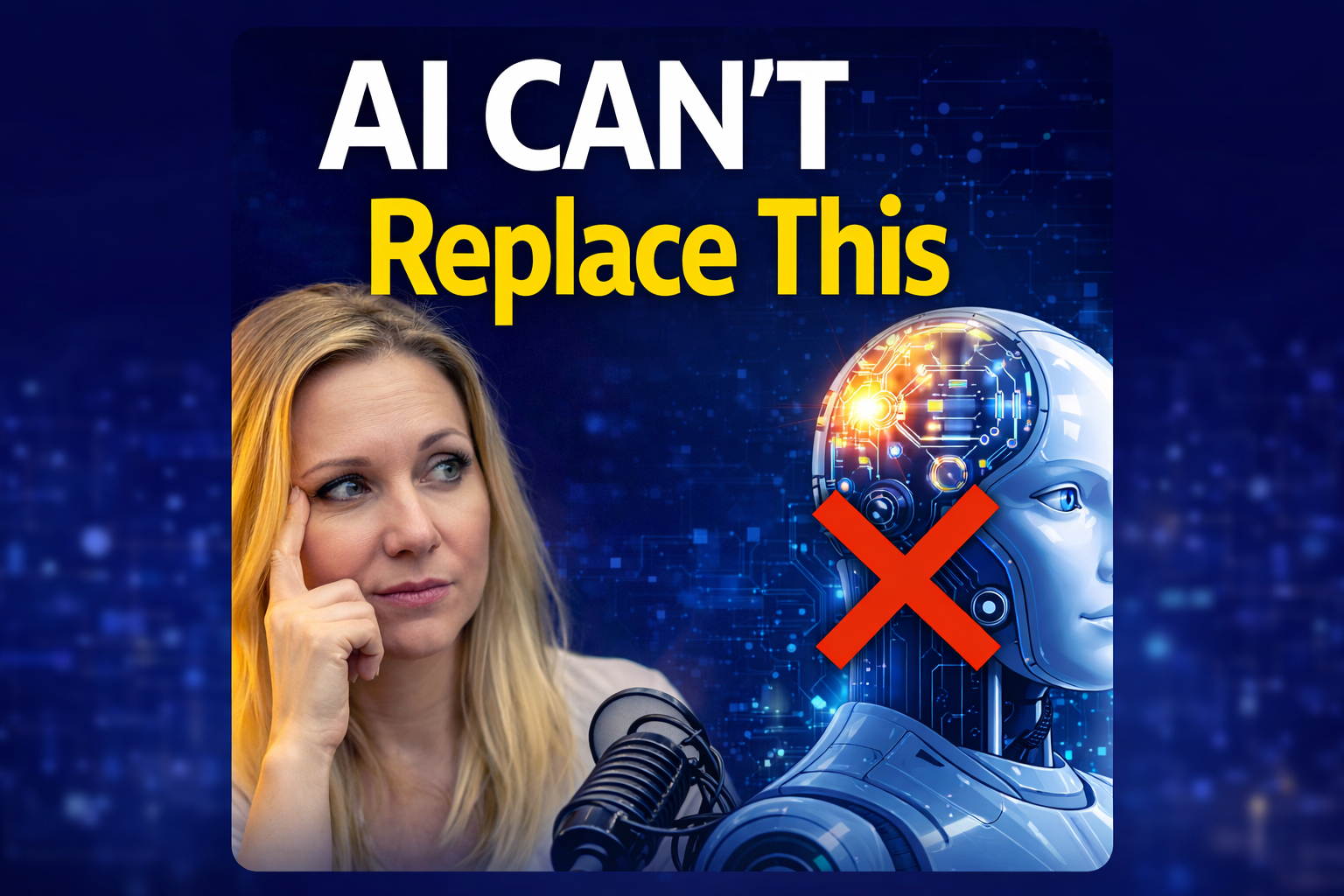
[00:00:17] Richard Gearhart: The technical piece will be taken over by AI, but the soft part is something that AI can't duplicate, at least not in the foreseeable future.
[00:00:26] Elizabeth Gearhart: Google told me, you wasted the first five seconds of this short. Nobody's going to watch it. So then you can try and I think that worked better.
This is Real AI Use Cases Business Owners Roundtable with hosts Elizabeth Gearhart, podcast consultant, marketing expert and PhD researcher using AI every day. And Richard Gearhart, entrepreneur, seasoned business owner and intellectual property attorney specializing in innovation. Here's how real companies are using AI right now. Now it is time for real AI Use Cases where I'm going to ask everybody for one whether using AI, their most recent thing they did or their favorite way, the most fun way. Giuseppe Grammatical, you've been sitting there so patiently. Why don't we start with you on
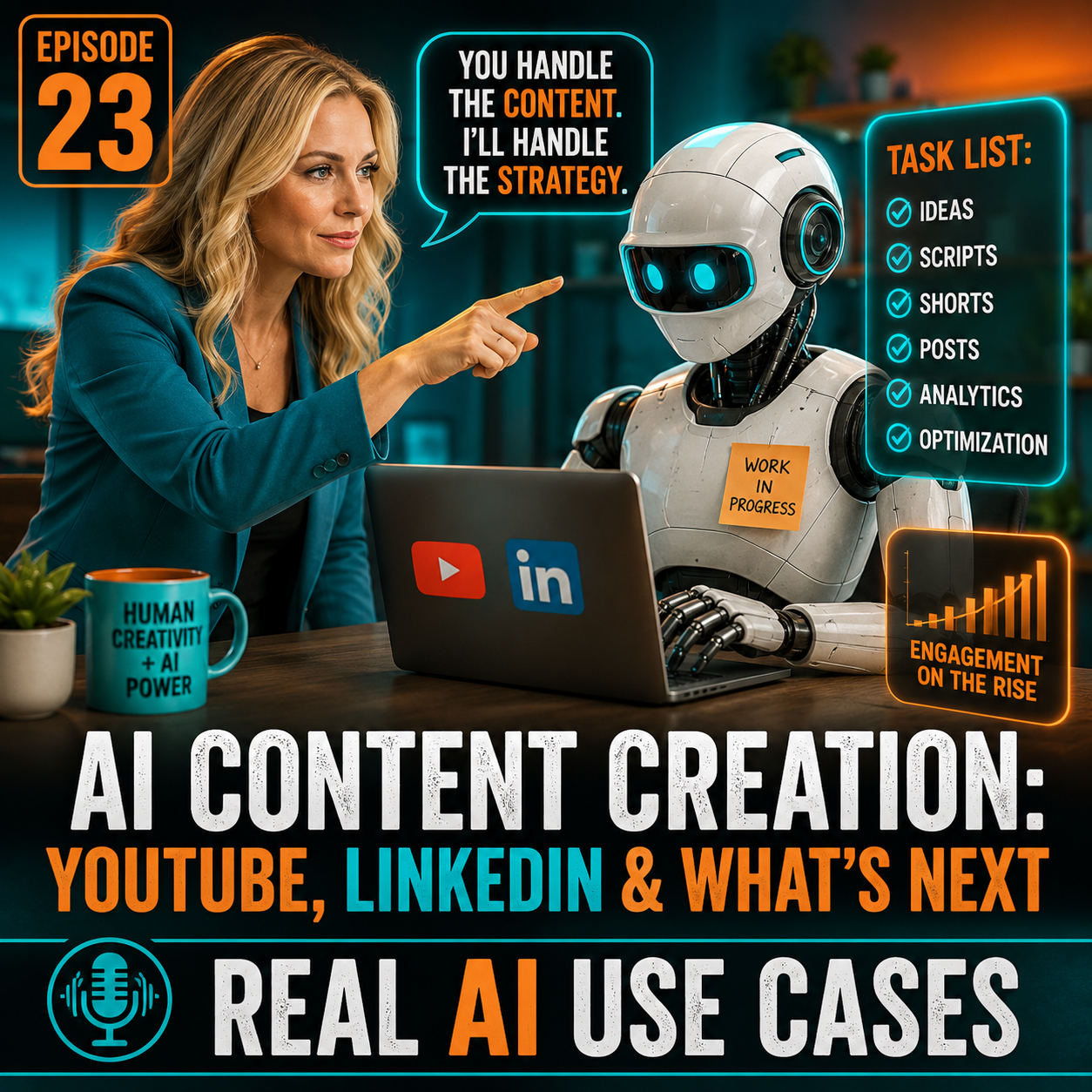
[00:01:09] Giuseppe Grammatico: this one, How I've been using AI. It starts from the very beginning. AI will scan our website, it'll scan all our social media and give us the topics we should be talking about with the hook already built in. So grabbing attention, giving a topic that people are interested in and, and then from there the AI will actually chop up our YouTube, our shorts and things like that. And then we have a human editor that'll go in and check the shorts, send it to me for approvals. It's cutting down on the content creation, the cost, the time it takes to do so, and it's giving us those hooks because what good is good content if the hook isn't there and you're not grabbing the attention so, so important.
[00:01:49] Elizabeth Gearhart: Okay, so back to you, Robert Tuckman.
[00:01:53] Robert Tuchman: I have been using it and using a certain AI that helps you create LinkedIn posts. And I will tell you that it has helped me just in coming up with interesting ways, interesting stories and then putting it together.
And it's been incredible. Just the engagement I've gotten from when I was writing my own basically LinkedIn posts.
[00:02:22] Elizabeth Gearhart: Excellent. Richard Gearhart, your favorite way or least favorite way?
[00:02:27] Richard Gearhart: I think we've been using AI to understand potential clients a lot better. As an intellectual property lawyer, most of the intellectual property of most companies is available online. You can go to places like Google Patents or the Patent Office and you can identify these databases. So if we are in the process of trying to woo a new client. One of the things that we can do is, is look at their intellectual property portfolio and we can analyze, makes it easy to identify gaps or maybe things that aren't quite as good as they could be.
And based on that, we're in a pilot program now where we're approaching potential clients, much to the chagrin of their current law firms. But to really try to help them and just point out that there are some things here that could be done better. So without totally geeking out, we have something called a patent term extension, which is a real technical way of calculating how long a patent lasts. And we can go in and see how those are being awarded by the patent office. And if the law firm doing the job right, they can have patents can have shorter term. So we're using AI to identify those kinds of things.
[00:03:42] Robert Tuchman: Things.
[00:03:43] Elizabeth Gearhart: And that was your idea. I know, we've talked about it for a while. That was brilliant.
[00:03:47] Richard Gearhart: Yeah, thank you.
[00:03:48] Elizabeth Gearhart: Especially for the drug companies because.
[00:03:51] Richard Gearhart: Right.
[00:03:51] Elizabeth Gearhart: For them, the longer their patent lasts, the more money they make because the generics can't come in and steal their research.
[00:03:57] Richard Gearhart: Yeah. I mean, it's less important for entrepreneurs because they have an exit strategy usually. So the patent term is less important than getting it. But once it's been adopted by a larger company that has longer term view, then it becomes super important.
[00:04:13] Elizabeth Gearhart: Me, Elizabeth Gearhart, I have been using it to really dig into YouTube shorts. I know we've all been talking about that here today. So there's gemini within the YouTube channel and I've been asking it how to improve the shorts. So the main thing is you want people to watch it and not swipe away.
And is it the title that matters most? What is it that matters most? And is it the time of day that you post? I've been doing my own research too. I found out some interesting things. Now, Robert tells me that they could be lies, some of them, which they probably, probably are. So I'm going to reinforce. I'm going to ask also Chat and Claude what they think about this advice from Gemini. But I'm really trying to optimize our YouTube shorts because if you post a video on YouTube, you get views, but if you post shorts, like our shorts have these huge spikes in views. Right. We're getting a thousand views per short.
So I want to consistently post shorts, but I want to do it the right way without like spamming people or whatever. So I'm really working on that with the different LLMs to try to Figure that piece out.
[00:05:19] Robert Tuchman: Another just a key thing there that goes back to our conversation also with the shorts and with YouTube. And from what I've learned from Audience Lift, it's also not just about the numbers, kind of like we talked about. It's the engagement. Are people watching the entire short? Are they? And that's really the one of the most important components.
[00:05:42] Elizabeth Gearhart: And yeah, so Google's told me. So I had Opus doing them. So I don't know if you guys know Opus. It's an AI program, right. And Google told me, well, you know, you wasted the first five seconds of this short. Nobody's going to watch it.
So then you can trim it in YouTube. So then I went into YouTube and trimmed them based on what that said and I think that worked better. And then it said, well, you really should use Descript to generate your shorts. But I had tried that before, maybe it's better now. I didn't like it because Descript was like cutting off half a person's face and stuff. But I'm going to try it again based on what Gemini is telling me. But yeah, that is the most important thing for shorts is that people stay and watch it. Right?
[00:06:24] Richard Gearhart: Some shorts I watch like two and three times.
[00:06:27] Robert Tuchman: Yeah, you see real engagement. And that also just to note, is super important to YouTube. So when they see engagement and I'm not giving away any secrets, but when they see a really heavy engagement like that, then they send more and more people to those shorts.
[00:06:49] Elizabeth Gearhart: And some of them that works for, you know who does the best on the shorts that I post? Richard. People love.
[00:06:56] Richard Gearhart: That's not true. You do better than I do.
[00:06:58] Elizabeth Gearhart: No, they stay and they watch you.
[00:06:59] Robert Tuchman: It could be his orange tie because it could be a lot of Texas Hook em fans.
[00:07:04] Giuseppe Grammatico: It could be puppy holding a puppy.
[00:07:07] Robert Tuchman: I heard somebody kittens, right?
[00:07:09] Elizabeth Gearhart: You're doing YouTube too. Are you playing around with shorts and seeing which ones work best?
[00:07:14] Giuseppe Grammatico: We are. We're looking for titles. We're looking for, is it a background image? Is it something. And we're noticing that the more specific, for example, how much money can you make with the franchise? Well, who the heck knows? There's so many different numbers I could throw at you, but people want like, wow, that's an exact question. Maybe that's something I actually put in Google or put in ChatGPT. So we're noticing those very direct what is the best franchise to own in 2026? Get a lot more hits than what are the five things to look for in a franchise? Which is a lot More general. So we've noticed that we have an AI agent that our marketing company had built and it scans and it looks for the top five posts every week and then we double down on those posts. That's something we just started doing. So why not double down on what's working as opposed to covering topics that people don't want to hear about?
[00:08:03] Elizabeth Gearhart: Well, yeah, and that's what YouTube tells you to do. And you know, I have to learn how to program these AI agents because I have so many things I want an agent to do. We have somebody that's working with the law firm on implementing AI, but it's going pretty slow.
[00:08:16] Robert Tuchman: I was just at a GTC Nvidia's conference. One of our clients has a podcast they were doing. It's amazing how many companies are out there and in it. We're at such the beginning of all of this that soon enough, like you're talking about using an AI tool that shows half a fate. Like that's going to get worked out. It's going to be incredible when you don't have to put in all that effort and work and you can really just utilize it, especially as entrepreneurs to build your business. Absolutely.
[00:08:51] Elizabeth Gearhart: Yeah. Well, we were at this conference, NJ Bio. Richard was on a panel. He was talking about the intersection of AI intellectual property and biotech startups and the ramifications of using AI in some of the research and different things and what the intellectual property considerations were.
And I was talking to somebody, this young woman, she worked for some drug company or something and she knew the name of one machine that they were using. And I had used that a long time ago. And I'm like, oh yeah, I remember when a long time ago they used to have to like the pen would make the graph for these compounds. They'd have to cut the paper out and weigh it to see the ratios of the compounds in this mixture.
[00:09:34] Richard Gearhart: Right.
[00:09:35] Elizabeth Gearhart: And now it's just all done. And now I'm sure with AI it's like spit out in two seconds. Then it got better where the computers did it. So yeah, we're on a trajectory.
[00:09:44] Robert Tuchman: I think it's pretty amazing. You know, just when you talk about technology and thinking of all of us as entrepreneurs and starting my first business, I remember we had one computer for everyone with one email to my first business. And then we had a fax machine where all the contracts would come in. So whenever we heard it ring, all the sales guys would jump up and like hoping it was their contract that was coming through, signed it. And now you just think of what's happened. It's absolutely incredible.
[00:10:17] Elizabeth Gearhart: But it will not replace people. Because we had a table and these two men came up that had a really good invention and they wanted to talk to Richard and they had seen him speak. And so I said, yes, we'll set up a meeting for you to talk to Richard. And so they didn't see him through our website. They didn't see him through any AI efforts at all. They saw him in person.
I think that's still going to have a place.
[00:10:42] Robert Tuchman: I absolutely agree. I think AI is going to be revolutionary. There's so many people. Because even like my wife is like, what should our daughter study at school? Like, should. Should she study? You know, plumbing? I'm just like, learn as much as you can about AI. At the end of the day, what she's great at is communication, talking to people. That's never going to go away. You're not going to be able to just be doing all of these things. Whatever AI can do for you to create, I truly believe it's going to make more opportunities, more jobs. I fully believe that there are two schools of thought.
[00:11:27] Elizabeth Gearhart: Right, Richard?
[00:11:28] Richard Gearhart: Yeah, I was just going to say, I was watching a video on, and it was the CMO of LinkedIn and she was saying that the more prevalent AI becomes, the more important soft skills will become, because the technical piece will be taken over by AI. But the soft part is something that AI can't duplicate, at least not in the foreseeable future.
[00:11:54] Elizabeth Gearhart: So, Giuseppe, do you think it's going to kill all our jobs or bring more jobs to replace the ones it does kill? Because it will kill jobs.
[00:12:01] Giuseppe Grammatico: It's going to definitely kill jobs, but it's going to create plenty of more. I truly believe there's going to be. Back in the day, when I worked on Wall street in 99, back in my. Payne Weber, back in the day, right before the UBS merger, you know, we couldn't trade. You had one. One person for an entire trading floor placing trades. You weren't able to even do that. E trade was just breaking in. So I think it's going to kill some jobs. And it's part of evolution, right? We're going to evolve. And the trades are doing really well. The plumbers, the electricians, as you mentioned. But how are they going to be able to use AI? So I think the jobs will change, but they'll just. You have to adapt. Just like every business owner out there, every employee is going to have to learn new skills and adapt their job May not be there, but there'll be another job. So I think the human element is. Nothing is going to take away from the human element.
[00:12:49] Elizabeth Gearhart: Yeah.
[00:12:49] Robert Tuchman: And just think back to. We can't think back, but reading about it, the Industrial Revolution. Right. People must have been freaking out where. How is this. I'm losing this job. Who's going to, like, pick the corn or whatever? Now I have this machine doing it. But that just helped to build and then to build more jobs and then more opportunities. So when you look at it, that's why I always just think of that analogy, because I really believe that with this technology and I've just seen it firsthand from using it, there is so much more opportunity to create businesses, to do different things that are gonna take more people.
[00:13:28] Elizabeth Gearhart: Yeah. And I don't know if they used AI to design the new train station here, the new Penn Station, or what they used to design that, but there are a bunch of restaurants, a huge amount of space, and two tiny little bathrooms.
[00:13:45] Robert Tuchman: Well, that's New York City for you. But I will tell you, if you have not been to New York City in a while and you go to Penn Station and Moynihan Station, you do not believe you are in New York City. In Penn Station, it's the same if you go or fly into LaGuardia Airport, which now when you're there, I always think when I'm flying in, I'm in another city.
It's incredible. Thank God. They've really picked up their game a little bit here in the last bunch of years.
[00:14:17] Giuseppe Grammatico: Yeah. And the AI should prevent the trains from breaking down. I had two canceled trains coming in today. We got to work on the trains.
[00:14:24] Robert Tuchman: I don't think they'll ever be able to in New York.
Fix that.
[00:14:29] Giuseppe Grammatico: All right.
[00:14:30] Robert Tuchman: In our lifetime, I can't even do that.
[00:14:35] Elizabeth Gearhart: There are things beyond AI well, this is so much for that.
Listen to our podcast, Real AI Use Cases Business Owners Roundtable, on YouTube and wherever you get your podcasts, you have
[00:14:45] Richard Gearhart: been listening to Real AI Use Cases Business Owners Roundtable.
[00:14:49] Elizabeth Gearhart: We hope you found this valuable. Join us again for more stories.
[00:14:52] Richard Gearhart: Because the future of business is driven by AI. This podcast was recorded at the iHeart
[00:14:56] Elizabeth Gearhart: Studios in Manhattan as part of the Passage to Profit radio show.