Show Notes
How are businesses actually using artificial intelligence to save time, automate tasks, and improve decision-making—and are the results worth the cost? On this episode of Real AI Use Cases Business Owners Roundtable, hosts Elizabeth Gearhart, Ph.D., and Richard Gearhart bring together business owners and AI practitioners to discuss practical applications of AI, the growing role of AI agents, and the risks of relying too heavily on automated systems.
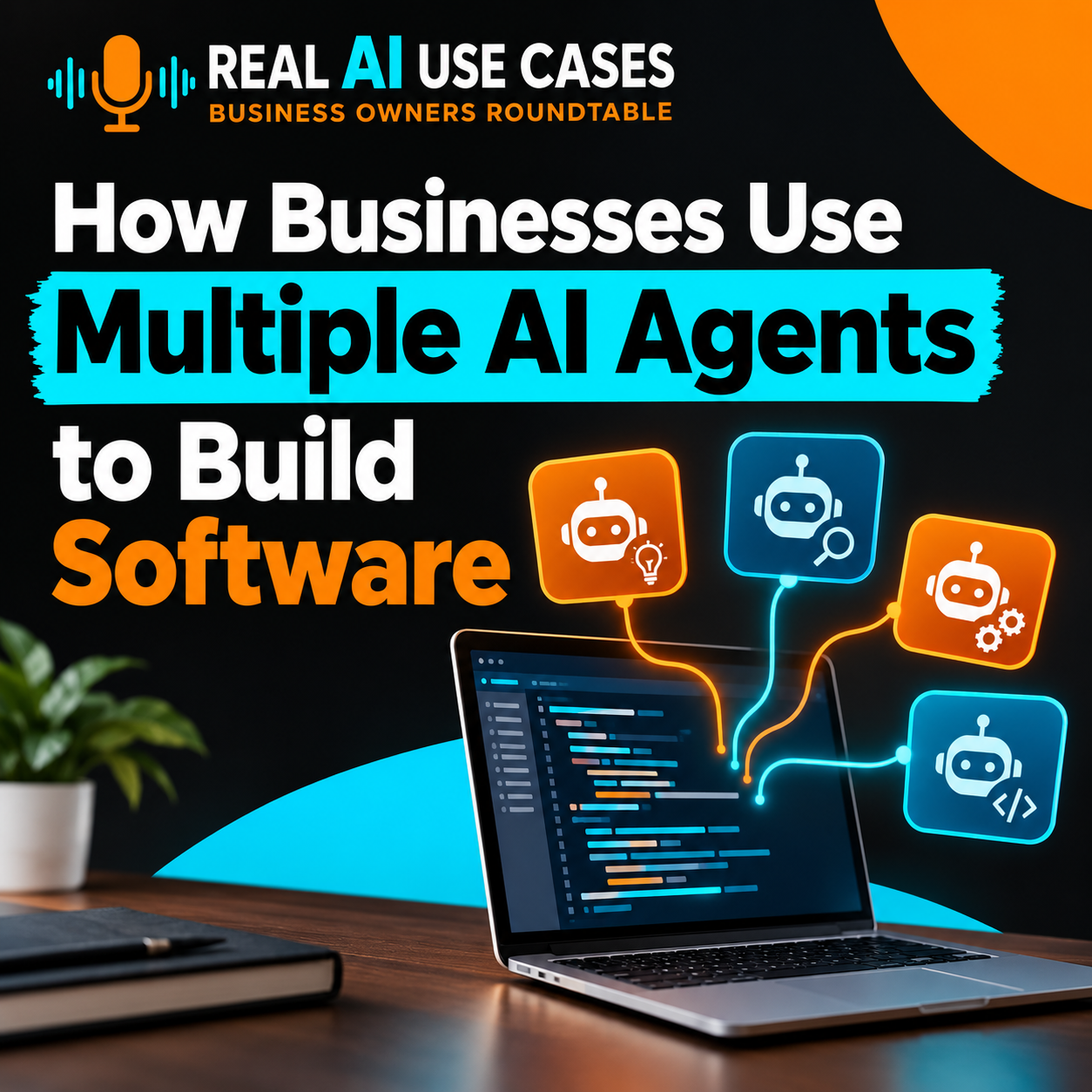
Todd Drowlette explains how AI transformed commercial real estate site selection, completing research that once took three full-time employees three weeks in just three and a half hours. Brandon Bellamy shares how he uses AI to identify comparable commercial properties and uncover new business opportunities. Sam Desany explains how he uses Claude, Codex, and multiple AI agents to turn early-stage ideas into working software through a structured process of brainstorming, refining prompts, and reviewing outputs. Richard Gearhart discusses using Microsoft Copilot to estimate business value and identify potential ways to improve it, while Elizabeth Gearhart shares how she is using AI to optimize podcast content for search and answer engines and help develop a book based on real business AI use cases.
But AI productivity comes with trade-offs. The panel examines the hidden costs of AI tools and usage credits, questions whether automation always delivers a return on investment, and discusses why businesses still need human judgment, reliable sources, and careful verification. They also explore AI hallucinations, leading questions that produce biased answers, financial data privacy, overreliance on AI, and the importance of keeping a human in control of consequential decisions.
Whether you're a small business owner, executive, marketer, entrepreneur, or technology professional, this episode offers practical insights into where AI can deliver measurable value—and where caution is essential.
TL;DL — Too Long; Didn't Listen
-
Automate repetitive work: AI reduced a commercial real estate research process from three weeks of full-time work by three people to just three and a half hours.
-
Discover new opportunities: Use AI to analyze property records, compare similar buildings, and identify potential buyers or business prospects.
-
Build better AI workflows: Multiple AI agents can brainstorm ideas, refine prompts, and help generate code.
-
Understand the true cost of AI: Usage credits, subscriptions, oversight, and human review can reduce expected savings.
-
Verify AI-generated answers: AI can hallucinate, overlook important context, and reinforce the assumptions behind a question.
-
Protect sensitive information: Be cautious about submitting confidential financial, customer, or business data to AI tools.
-
Keep humans in control: AI should support human expertise and critical thinking, not replace independent judgment.
Frequently Asked Questions:
How are businesses using AI to save time?
Businesses are using AI to automate research, analyze market data, identify commercial real estate opportunities, complete routine document tasks, generate code, and streamline content production. In one example discussed in this episode, AI reduced a research process from three weeks of work by three full-time employees to three and a half hours.
What are AI agents, and how can businesses use them?
AI agents are systems configured to perform tasks or sequences of tasks toward a goal. Businesses can use multiple agents to brainstorm ideas, refine instructions, review outputs, and assist with software development and workflow automation. Human review remains important before implementing consequential changes.
Does AI automation actually save businesses money?
It can, but the return on investment depends on the task, the tools used, subscription and usage-credit costs, implementation time, and the amount of human oversight required. Businesses should compare the total cost of AI against the cost and quality of the work it replaces or improves.
Can AI complete weeks of business research in hours?
AI can dramatically accelerate certain research tasks when it is connected to appropriate data sources and configured for the work. In this episode, a commercial real estate research process that previously took three people three weeks was completed in three and a half hours. Results still need to be checked for accuracy and relevance.
Can business owners trust AI for financial analysis or business valuation?
AI can provide preliminary estimates, valuation ranges, and ideas for improving a company's value. However, its outputs are not substitutes for a professional valuation or independent financial advice. Business owners should validate assumptions and results with qualified advisers.
Why do AI tools sometimes give incorrect or biased answers?
AI systems can generate inaccurate information, miss relevant context, and reflect assumptions embedded in a prompt. Asking a question in a leading way may encourage an answer that confirms the user's expectations. Comparing independent sources, checking primary evidence, and using different models can help identify potential errors.
What are the risks of putting confidential business information into AI?
Depending on the tool, settings, and applicable data policies, sensitive information submitted to an AI system may create confidentiality, privacy, or security risks. Businesses should review the provider's data-handling terms, use appropriate enterprise protections where needed, and avoid entering sensitive information into tools that have not been approved for that purpose.
Will AI replace employees or make businesses less efficient?
AI may automate some tasks, but it also introduces costs related to implementation, supervision, errors, and usage. Some workflows may be more efficient with AI, while others may be better handled by people. Businesses should measure actual results rather than assuming automation automatically reduces costs.
How can businesses use AI without losing human judgment?
Start by thinking through the problem independently, use AI to support research or execution, verify important claims against reliable sources, and require human approval for consequential decisions. AI is most useful when it strengthens human capabilities rather than becoming a substitute for critical thinking.
What is the best way for a small business to start using AI?
Identify a repetitive, time-consuming task with a measurable outcome. Test an AI workflow on a limited scale, check its accuracy, calculate the full cost, and compare the results with the existing process. Expand only when the benefits justify the expense and risks.
Listen to Real AI Use Cases Business Owners Roundtable for practical examples of how businesses are using AI today—without ignoring the costs, limitations, and need for human oversight.
Chapters
- (00:00:00) - Intro: AI's Potential Dangers Teaser
- (00:00:36) - Todd Drowlette: AI for Real Estate Site Selection
- (00:02:03) - Brandon Bellamy: Using AI as a Lens, Not a Crutch
- (00:03:16) - Sam Desany: Multi-Agent Coding Workflow
- (00:04:16) - Explaining the Multi-Agent System Simply
- (00:06:17) - Richard Gearhart: Business Valuation via AI
- (00:07:17) - Writing a Book from Podcast Content Using AI
- (00:08:28) - Naming the Book: Real AI Use Cases
- (00:09:02) - Could AI Kill Us All?
- (00:09:34) - AI Risks: Human Oversight and Job Costs
- (00:09:54) - ROI Concerns and Rehiring After AI Layoffs
- (00:10:54) - AI as a Tool, Not a Replacement for Thinking
- (00:11:43) - Bioweapons and Bad Actors vs AI Takeover
- (00:12:21) - AI Bias, People-Pleasing, and Verifying Answers
- (00:13:32) - Over-Reliance on AI and Losing Problem-Solving Skills
- (00:15:02) - Explaining AI Agents and Closing Remarks